
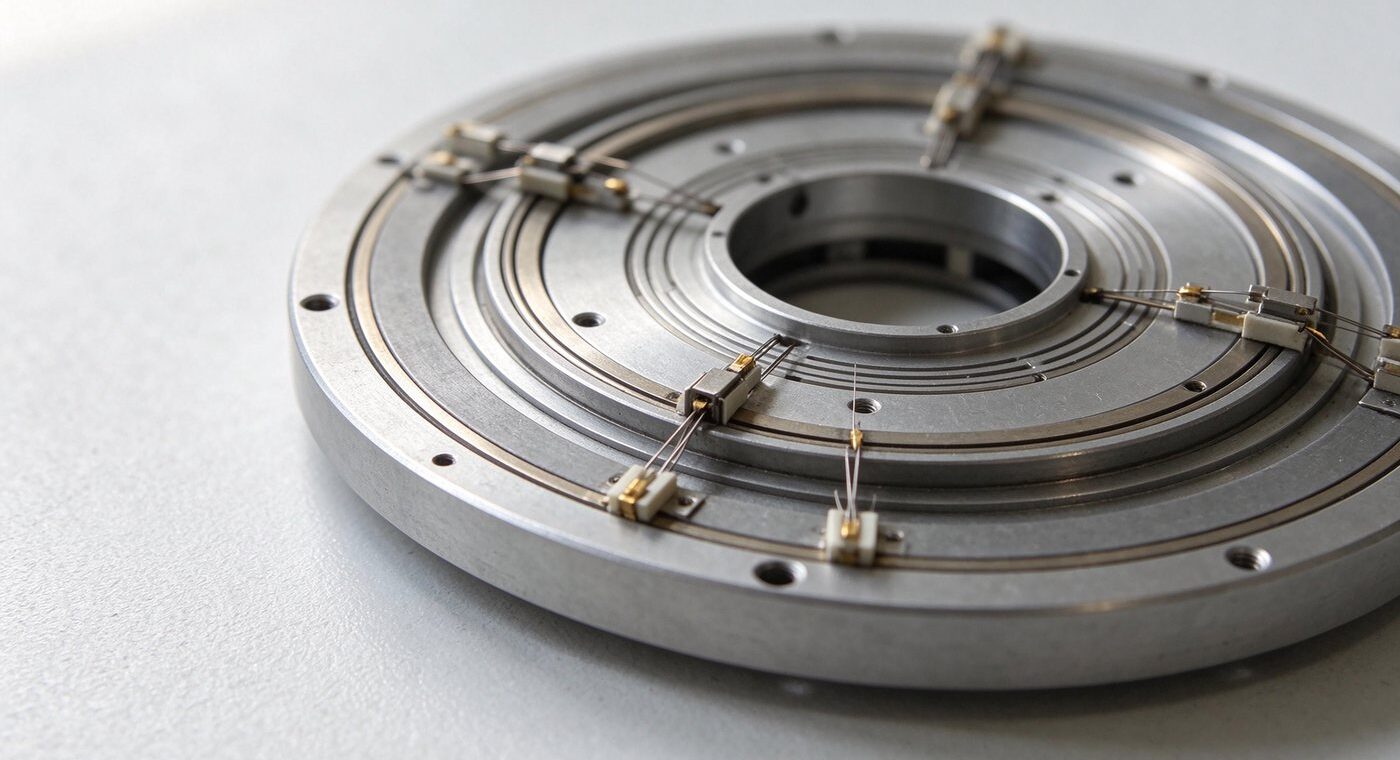
Both designs solve the same electrical problem. The mechanical envelope decides which one fits, and the duty decides which one lasts.
Through-bore: when something must pass through
A hollow centre allows a shaft, a cable bundle or a hydraulic line to pass through the ring. The ring sits around the rotating element rather than on top of it, which often reduces overall machine height. The trade-off is diameter: bore plus stack plus housing wall.
Pancake: when height is the constraint
A flat disc puts the contact path on a large radius and keeps the assembly short. Under a turntable or a stage deck this is often the only geometry that fits. The trade-off is speed: large radius means higher surface speed at the brush, which limits rpm.
Decision rules we use
- If a shaft or cable passes through the axis, start with through-bore.
- If axial height is under about 50 mm, start with pancake.
- If rotation exceeds 1,000 rpm, prefer a cylindrical design with a smaller radius.
- If the load is an indexing table at low speed, a large pancake is usually the most durable answer.
The usual mistake
Buying a pancake because it looks tidy, then running it at 800 rpm. Surface speed at a 300 mm radius is roughly four times that at 75 mm, and brush wear follows surface speed. If the machine indexes at 5 rpm, the pancake is excellent. If it spins continuously, reconsider.
Send the available envelope with the enquiry and we will propose the geometry that fits it, with the speed limit stated rather than implied.
Need this checked against your application?
Send the operating parameters and our engineering desk will confirm whether a standard unit fits or a custom envelope is required.
Request engineering review