
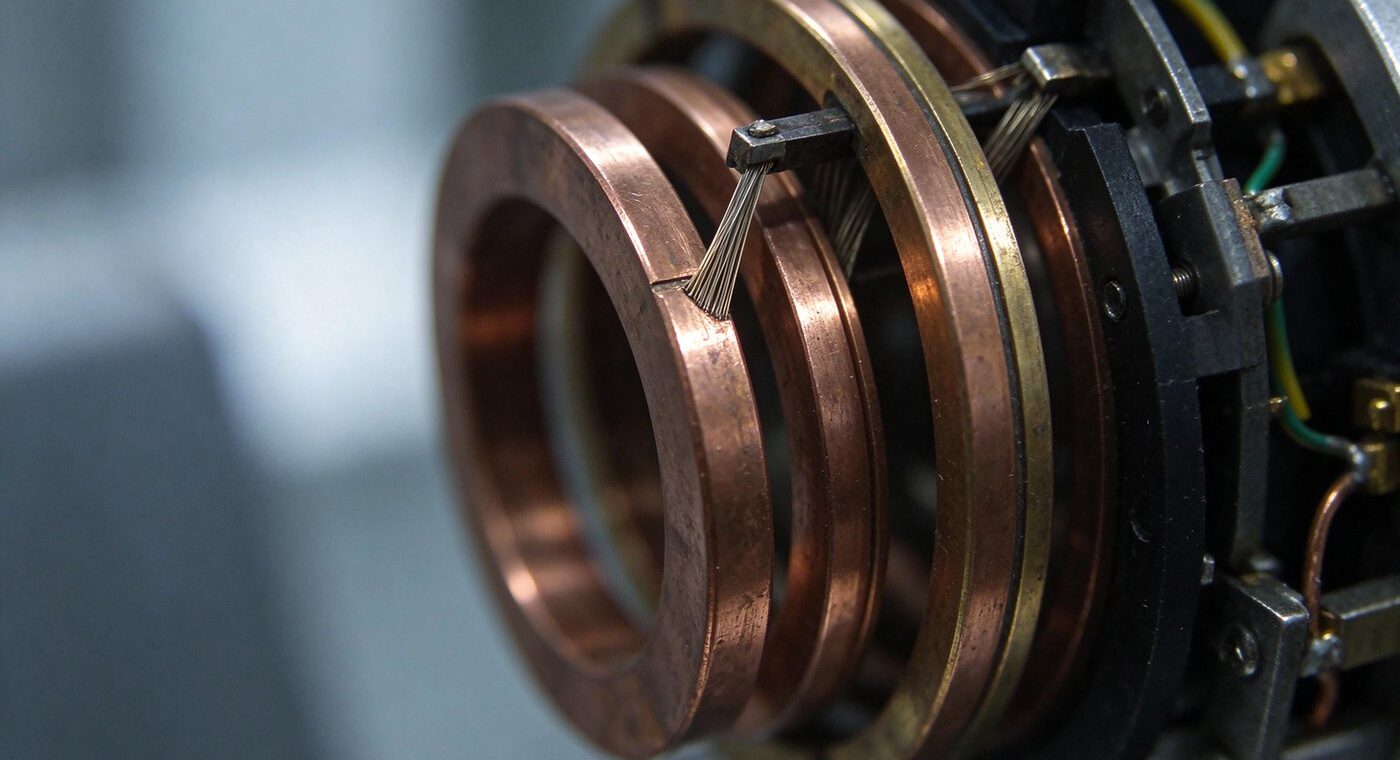
Contact material selection is usually made once per product family and then inherited by every variant. Getting it wrong is expensive, because the symptom appears months later in the field.
Gold alloy: for dry circuits
Gold does not oxidise, which makes it the correct choice for low-level signals: encoders, thermocouples, low-current control. Its limitation is current capacity and cost. Above a few amps, gold contacts become large and expensive, and the material is soft enough to wear under high force.
Silver-graphite: for power
Silver-graphite brushes carry high current with low drop and tolerate the arcing that comes with inductive loads. Graphite provides the lubricity that keeps wear predictable. The trade-off is that silver sulphides in polluted atmospheres, so silver-graphite is a poor choice for low-level signals in industrial air.
Gold-plated beryllium copper: for RF and high frequency
Where the signal is above a few hundred megahertz, contact geometry and plating matter as much as the base metal. Gold-plated beryllium copper keeps spring force stable and plating thickness controlled, which holds impedance and insertion loss within specification through rotation.
Mixed stacks
Most real assemblies use at least two materials: gold on the signal block, silver-graphite on the power block. Physical separation prevents silver debris from migrating onto gold contacts, which is a common cause of intermittent low-level faults.
What we ask customers
Signal level, current, environment and life target. From those four we propose the material and state the limits in writing. If the application is marginal, we build two samples with different materials and test both.
Need this checked against your application?
Send the operating parameters and our engineering desk will confirm whether a standard unit fits or a custom envelope is required.
Request engineering review