Robot joints do not rotate like a motor shaft. They accelerate, decelerate, reverse and sit still for hours, then repeat several million times over life. That duty profile, not the headline speed, decides whether a slip ring survives.
Contact noise is the real specification
On a wrist carrying an encoder or a fieldbus, a 200 µs contact interruption is invisible on a multimeter and fatal to the drive. Our capsule designs use per-circuit brush force so that reversing rotation does not momentarily lift a brush; the dynamic noise trace is recorded during final test.
Space, again
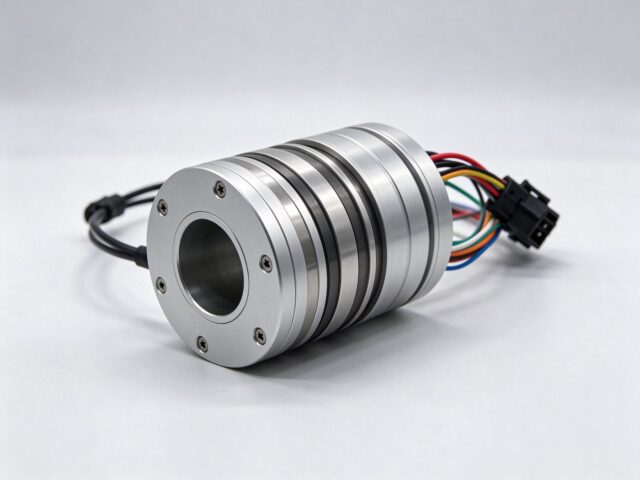
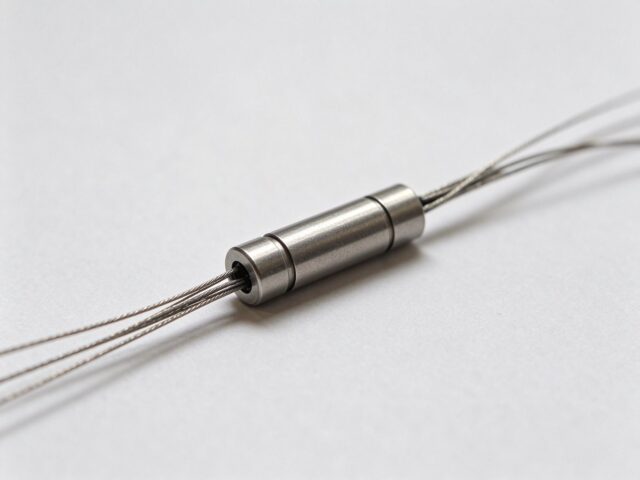
The wrist is usually the tightest joint on the robot. CAP012 and CAP020 capsules fit inside a tool flange; DHT038 handles twelve circuits with pass-through for a small pneumatic line. Where the joint also needs position feedback, the DHZ-32-8A integrates an absolute encoder into the ring housing.
What to send us
- Circuit list and current per circuit, plus signal type for encoder or fieldbus.
- Cycles per year and the reversing pattern, so brush force and material can be chosen.
- Available axial and radial space in the joint, with the mounting surface.
- Whether the ring rotates with the wrist or stays with the forearm.