
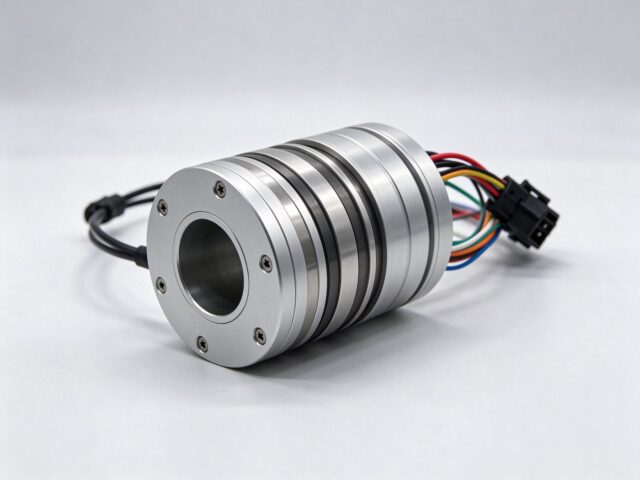
DHT110-36-10A Through Bore Slip Ring, 110 mm Bore
A mid-size hollow-shaft slip ring with a 110 mm bore for cable and shaft…
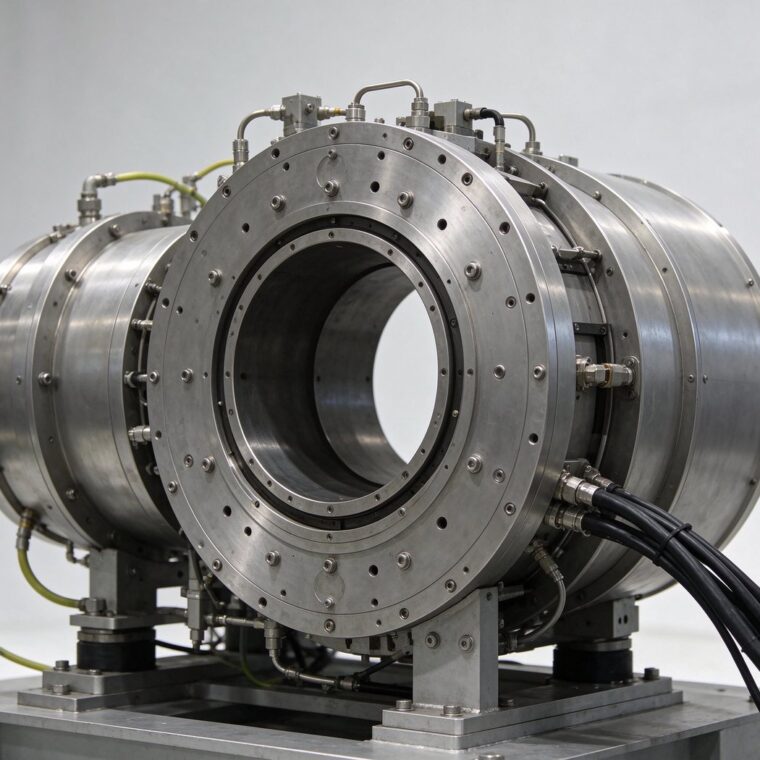
DHK240-231-2Y | dimensions in mm unless noted
A 240 mm through-bore assembly that carries 231 signal circuits, two power circuits and four hydraulic passages in one sealed housing, built for crane slewing and offshore winch drums.
Lead time: 15–25 working days for standard variants · prototypes from 10 working days. MOQ from 1 pc for evaluation.
The DHK240-231-2Y exists because crane and winch designers ran out of space. Instead of stacking a slip ring, a hydraulic rotary union and an encoder on the same shaft, this assembly integrates all three around a 240 mm through bore, so the wire rope, hydraulic lines and position feedback pass through one mechanical interface.
Every separate component on a slewing shaft adds stack height, run-out and an alignment tolerance that has to be absorbed somewhere. Combining functions reduces the axial length by roughly 40% compared with three discrete units, and removes two couplings that would otherwise need maintenance access inside a nacelle or a crane house.
| Bore diameter | 240 mm |
|---|---|
| Circuits | 231 signal + 2 power |
| Power circuit rating | 250 A per circuit |
| Signal circuit rating | 5 A each |
| Voltage | 690 V AC max |
| Fluid passages | 4 (hydraulic, up to 25 MPa) |
| Sealing | IP65 (IP68 optional) |
| Rotation speed | 30 rpm max |
| Temperature range | -40 to +85 °C |
| Housing | Anodised aluminium, stainless options |
| Termination | Cable harness, terminal blocks |
| Interface | Flange mount, shaft or housing rotation |
Values above are typical for the standard build. Tighter tolerances, alternative materials and extended temperature ranges are available on request.
Send a 2D envelope drawing or a reference photo — we work from both. NDAs are signed before confidential drawings are exchanged.
Discuss a custom variant
A mid-size hollow-shaft slip ring with a 110 mm bore for cable and shaft…
A short, light through-bore ring for robot wrists and small rotary heads: 38 mm…
A 60 mm bore through-hole slip ring with 24 circuits at 5 A, sized…
Send the duty cycle, envelope limits and interface types. You will get a data sheet marked up against your requirements, not a catalogue page.
Circuits, current, bore size, IP rating, temperature — give us the parameters and our engineers return a feasibility note, drawing and quotation within 24 working hours.